
Legal strategy
Kelly McCann · Attorney
Connect the building evidence, potential responsibility and payment sources to a legal strategy.
Our Approach
Getting repairs paid for starts with understanding what the work requires.
Insurance and legal analysis help identify who may owe payment. The needs of the owner, residents, or business shape the decisions along the way. We bring those questions together.
A proposed resolution can fall short if it is assessed without the repair requirements, timing, and owner’s circumstances.
One coordinated strategy
A property problem is rarely just about the cost of repair. It can raise questions about insurance coverage, what work actually needs to be done, how residents or tenants will be affected, and what the owner should do next. We look at those issues together, drawing on experience and insurance claims, construction, community associations, commercial real estate, and law. Our goal is to figure out what happened, what it will take to fix it, what evidence matters, and what options the owner has from there.
Connected around your property and priorities.
Your multidisciplinary team
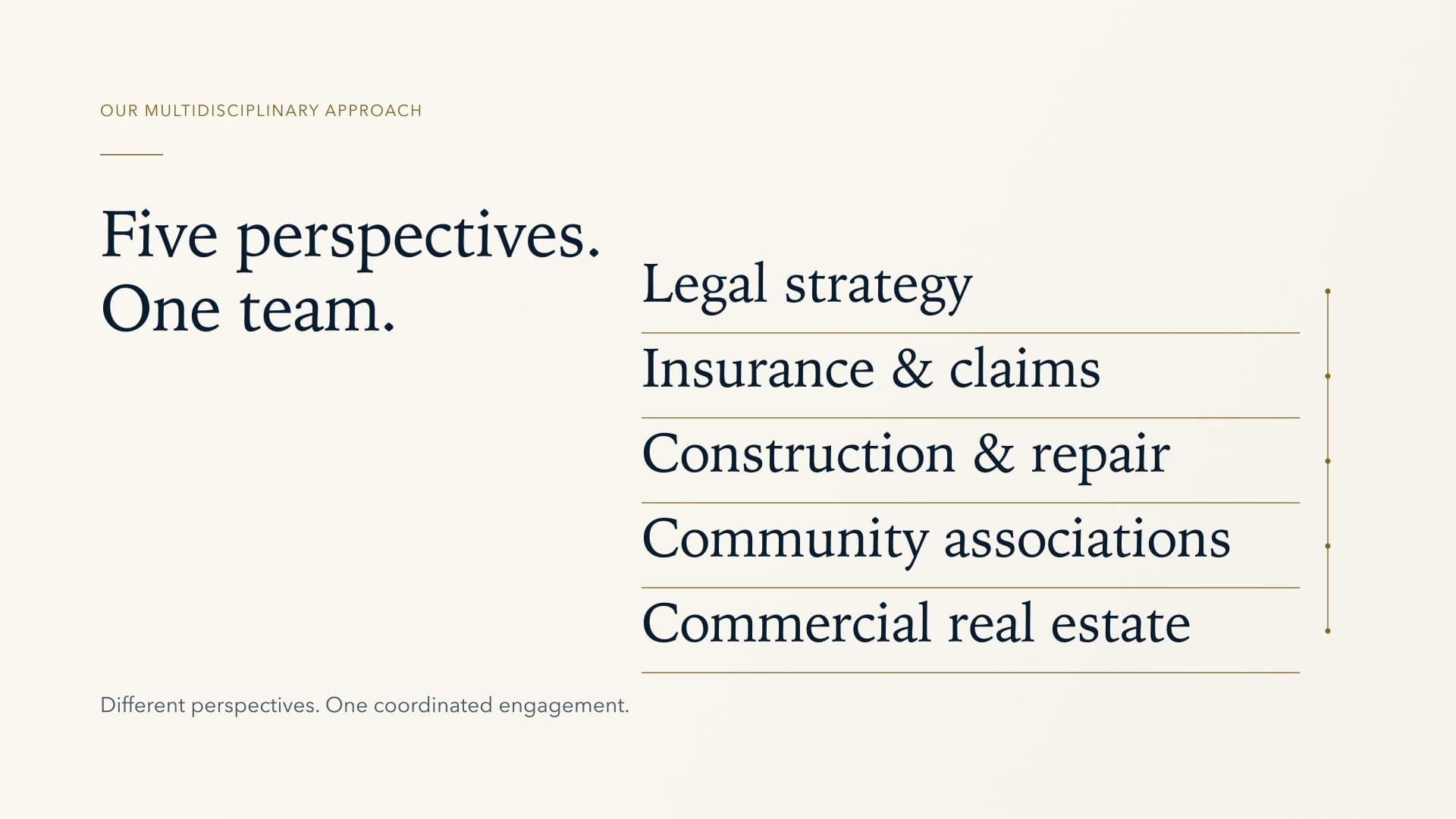
Construction, insurance, community association management, commercial real estate and law each contribute something different. We combine those perspectives in one plan, with involvement tailored to the matter.
Kelly McCann · Attorney
Connect the building evidence, potential responsibility and payment sources to a legal strategy.
Sarah Harper · Insurance & Property Claims Advisor
Identify gaps between the repair evidence, the claim file and the insurer’s stated payment position.
Former construction superintendent
Test whether a proposed repair accounts for access, sequencing, affected assemblies and the work needed to put the building back together.
Community association management expert
Bring board decisions, resident access, owner communication and funding pressures into the repair-and-recovery plan.
Commercial real estate expert
Connect repair timing to tenants, operating income, carrying costs and the owner’s constraints.
From engagement to the next decision
The plan changes as evidence arrives. Updates explain what changed, what happens next and whether the client needs to act. Major choices receive a separate decision memorandum.
Client update · excerpt
The proposal is ready for the team’s review. No approval is requested in this update.
The specialist has provided a scope for openings near the two windows with reported staining. The proposal identifies the locations and access needed.
The team is checking whether those locations can answer the water-entry and concealed-damage questions, and how the findings will be recorded.
Please confirm who will coordinate resident access. We will return with the scope, fee and access arrangements for the board’s decision.
Hypothetical example. No client matter or result is depicted.
How the team works together
A building finding changes the claim questions, the investigation scope and the decision brought to the client. The perspectives involved depend on the property and the work needed.
Team walkthrough
One condominium scenario, followed through the next board decision.
Construction & repair
The construction perspective helps frame the specialist’s investigation: trace the water-entry path and document concealed materials. Openings are proposed at the two locations with recurring staining.
Insurance & claims
The insurer has asked for evidence of concealed damage. The claims perspective identifies what the specialist’s report needs to record and what the proposed openings may leave unanswered. That informs the investigation scope.
Community management & law
Management works through resident access. Legal review addresses evidence preservation and claim deadlines. The board receives the written scope, fee and access arrangements, with an explanation of what the investigation can establish.
Hypothetical example. No client matter or result is depicted.
Published results
Construction and insurance disputes require different evidence. These published matters show the work and the result for each owner.
Explore all case resultsCondominium construction
Building-wide siding and window repairs for a 12-unit condominium.
Built the defect proof and secured a complete repair program with owner-side oversight.
Read the resultCommercial insurance
A Portland strip-center water loss and insurance shortfall.
Brought policy language, repair pricing, code upgrades, and loss-of-rent evidence into the claim.
Read the resultRepresentative results are examples only. Every matter depends on its own facts, evidence, timing, contracts, policies, parties, defenses, damages, and applicable law. Past results do not guarantee future outcomes.
Really how we're able to do that is because we have people on our team who have worked in these fields for decades. For example, we have a former senior claims adjuster on our team that worked at large insurance companies. And then, likewise, what we do is, for the construction company, we do something kind of similar, and that we've got a former senior superintendent on our team, who really knows a lot about, you know, the construction issues and how construction works. We also have a community manager, for HOAs on our team, and this really helps us communicate, with the board of HOAs, understanding that they're volunteers, how to reduce the load on that and make things very easy and make communication with the homeowners very easy, when we represent HOAs. And likewise, we have a commercial real estate expert on our team as well that really helps us communicate, the claim resolution process to especially limited partners in these real estate development process, so that they understand in a way that's, very easy to go down and very, and very kind of simple, but accurate.
From analysis to action
Put the evidence to work in pursuit of the owner’s objectives.
These are connected parts of the work, not a fixed sequence. New evidence or a changed position can require us to revisit the proof, the decision, and the next move.
Connect the physical condition and repair requirements to supporting evidence. Investigate what failed, preserve the proof, and document relevant household, community, or operating impacts.
What happened? What can we prove?
Assess who may be responsible and where payment may come from. Identify who has decision-making authority and which factual or legal issues shape the other side’s position.
Who can change the outcome?
Pursue negotiation or litigation as the matter requires. Evaluate each next step and proposed resolution against the evidence, risk, timing, repair needs, and owner’s objectives.
What should happen next?
So, number one, it's always our client’s decision whether or not to settle or go to trial. It's always their decision. We don't decide whether or not to go to trial, they do. And, and so we, what we do is we walk our clients through, usually it's kind of like a spreadsheet, but talk about different possible outcomes from a trial, including the appellate risks and the risk of adverse rulings at trial, and the benefits of good rulings at a trial, and really walk them through it, and then, you know, let our clients decide what, basically, the math dictates. Does it make sense to do it or does it not make sense?
The owner’s priorities
Practical impacts shape decisions; whether they are legally recoverable depends on the facts and applicable law.
Homeowners
Durable repairs, temporary housing, disruption, and household costs help define the owner’s priorities for resolution.
Associations
The board needs to weigh repair options, communicate with owners, and plan around access, disruption, and funding pressures.
Commercial owners
Restoration timing affects tenants, income, and carrying costs. Those operating pressures help shape the owner’s decisions.
 Kelly McCannAttorney
Conversations with our team
What does getting repairs paid for involve? Who controls payment? How do you weigh settlement against trial? Explore the questions that matter to property owners.
Explore the video libraryStart with your property
Tell us what happened, what needs to be fixed, and what the disruption means for you. You do not need a complete file to begin.